How to Register a Medical Device in India | The Complete 2026 CDSCO Guide
Learn how to register a medical device in India: CDSCO classes, MD forms, documents, fees and timelines explained step by step for 2026.

How to Register a Medical Device in India - 2026 CDSCO Regulatory Guide
If you plan to make, import or sell a health product here, the first thing to work out is how to register a medical device in India. The short answer: classify the device by risk, choose the correct licence form, and file a complete dossier with the Central Drugs Standard Control Organisation (CDSCO) or your state regulator. The long answer is where most companies lose months.
One mismatch between your label, your Free Sale Certificate and your device list can trigger a query. Each query adds weeks. Qualio's overview of the CDSCO process puts typical review at three to six months for lower-risk devices and six to twelve months for higher-risk ones.
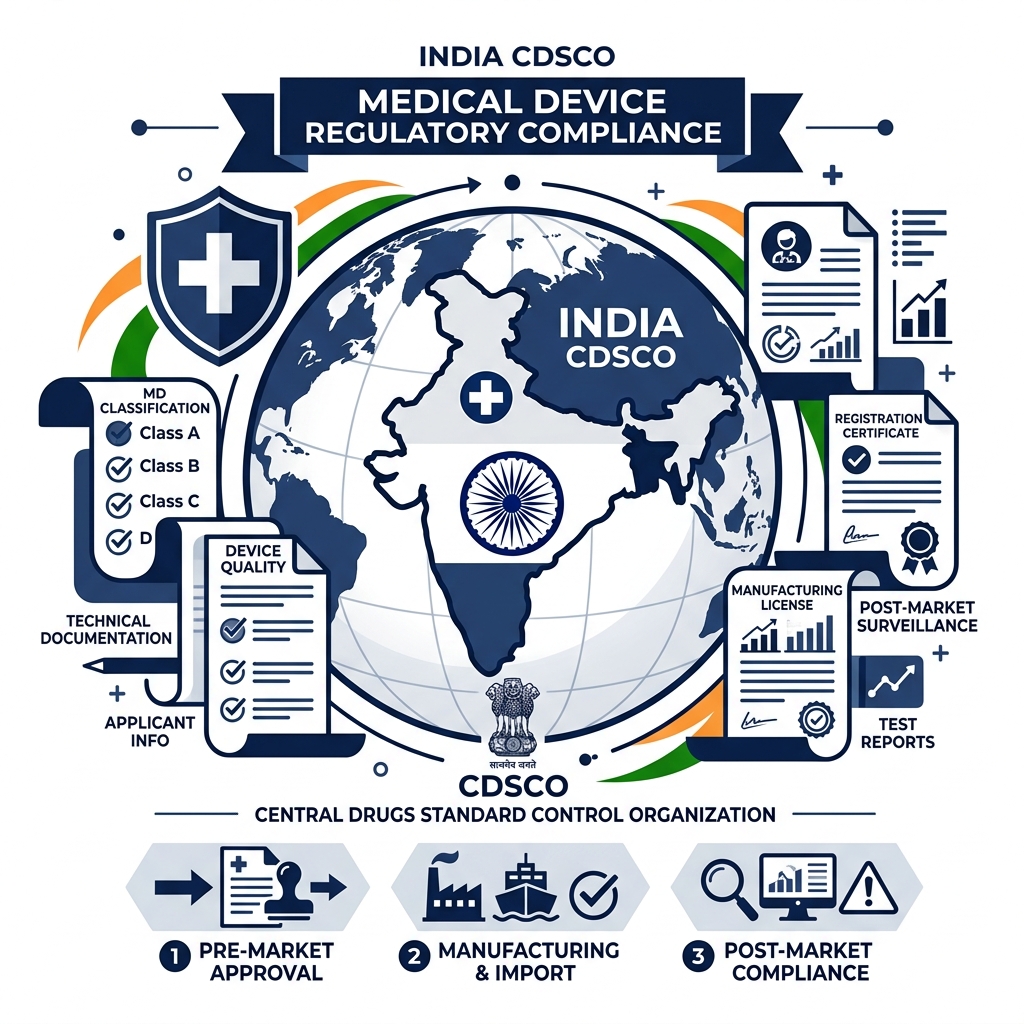
This guide explains how to register a medical device in India under the Medical Devices Rules 2017. You will learn the risk classes, the MD forms, the documents reviewers check, realistic fees and timelines, and the rule changes CDSCO made in 2026.
What Does It Mean to Register a Medical Device in India?
People say "registration" in everyday speech. Under Indian law, you mostly need a licence. CDSCO registration is the umbrella term the industry uses for both.
India regulates devices under the Drugs and Cosmetics Act, 1940 and the Medical Devices Rules, 2017 (MDR 2017). The rules cover instruments, implants, software, reagents and in vitro diagnostic (IVD) kits that diagnose, treat or prevent disease. If you work with test kits, our IVD regulatory page covers the extra points for diagnostics.
A medical device license in India gives you the legal right to manufacture, import, stock or sell a device. Without one, customs can hold your shipment, hospitals can reject your tender bid, and inspectors can seize stock.
There is one lighter route. Class A devices that are non-sterile and non-measuring (often shortened to NSNM) skip the full licence. Their makers and importers still list the product on the CDSCO online portal.
Why CDSCO Registration Matters for Your Business in 2026
Anyone researching how to register a medical device in India soon learns that the regulatory net is far wider than it was five years ago. India started with a short list of "notified" devices. Class A and B devices came under compulsory licensing on 1 October 2022, and every Class C and D device followed on 1 October 2023.
That shift changed how buyers behave. Hospital procurement teams, e-commerce marketplaces and distributors now ask for your licence copy before they raise a purchase order.
A licence also opens export doors. CDSCO issues Free Sale Certificates and Market Standing Certificates only for licensed devices, as its medical device and diagnostics guidance page shows. Overseas buyers and regulators often ask for exactly these papers.
Early compliance also cuts rework. When you build your ISO 13485 certification, technical file and labels around Indian rules from day one, you avoid rewriting them after the first query letter arrives.
Who Regulates Medical Devices in India?
Before you plan how to register a medical device in India, know who makes the decision. CDSCO works under the Directorate General of Health Services in the Ministry of Health and Family Welfare. The Drugs Controller General of India (DCGI) heads it and acts as the Central Licensing Authority (CLA). Its headquarters sits at FDA Bhawan in New Delhi, backed by zonal, sub-zonal and port offices.
Two authorities split the licensing work:
- Central Licensing Authority (CLA): Handles all imports, Class C and D manufacturing, clinical investigations and formal risk classification.
- State Licensing Authority (SLA): Located in each state, handles Class A and B manufacturing licences.
- Notified Bodies: Private audit firms registered with CDSCO that inspect Class A and B manufacturing sites before the SLA decides.
Drug-device products, such as a pre-filled syringe or a drug-coated stent, need extra thought. Start from the product's primary intended purpose. Our guide on borderline product classification walks through that reasoning.
Step 1: Classify the Device
Classification drives almost every later decision: who reviews your file, which form you use, what you pay and how long you wait.
MDR 2017 uses a four-level risk classification: Class A, B, C and D. CDSCO publishes product-wise lists by clinical area, such as cardiology, orthopaedics and IVDs. Search for your device on the CDSCO medical device page first.
If your product is missing or unclear, ask CDSCO for an official ruling. The CDSCO MD Online portal has accepted risk classification applications for medical devices since 27 November 2025 and for IVDs since 18 February 2026.
Base the class on your intended use and claims, not on how a competitor labels a similar item. A dressing that only covers a cut sits lower than one that claims to manage deep wounds.
How Class A, B, C and D Devices Differ
| Class | Risk Level | Typical Examples | Manufacturing Licence From |
|---|---|---|---|
| Class A | Low | Tongue depressors, non-sterile bandages | State Licensing Authority |
| Class B | Low to moderate | Hypodermic needles, suction equipment | State Licensing Authority |
| Class C | Moderate to high | Ventilators, orthopaedic implants | Central Licensing Authority |
| Class D | High | Heart valves, coronary stents, HIV test kits | Central Licensing Authority |
IVDs use the same four letters but follow their own classification rules. A kit that screens donated blood usually lands in Class D, because a wrong result can harm many people at once.
Step 2: Choose the Right Licence Route
With the class fixed, how to register a medical device in India splits into separate paths, so match the class to your business model. Will you make the device in India, import it, or only test it? Each answer points to a different pair of forms.
| Route | Apply On | Licence Issued | Granted By |
|---|---|---|---|
| Manufacture, Class A/B | Form MD-3 | Form MD-5 | SLA (after notified-body audit) |
| Loan licence, Class A/B | Form MD-4 | Form MD-6 | SLA |
| Manufacture, Class C/D | Form MD-7 | Form MD-9 | CLA (CDSCO inspection) |
| Loan licence, Class C/D | Form MD-8 | Form MD-10 | CLA |
| Import, any class | Form MD-14 | Form MD-15 | CLA, via an Indian agent |
| Test licence, manufacture | Form MD-12 | Form MD-13 | CLA |
| Test licence, import | Form MD-16 | Form MD-17 | CLA |
| Class A non-sterile, non-measuring | Online registration | Registration number | CDSCO portal |
Manufacturing Licences (MD-3 to MD-10)
Indian makers of Class A or B devices apply on Form MD-3 and receive Form MD-5 from the SLA. A notified body audits the site first. Class C and D makers apply on Form MD-7 and receive Form MD-9 straight from the CLA, which sends its own inspectors.
Loan licences suit brand owners who use another company's licensed plant. They follow parallel forms: MD-4 to MD-6 for lower-risk devices, and MD-8 to MD-10 for higher-risk ones.
Our note on preparing a CDSCO manufacturing licence shows how to line up site and product evidence in a single filing.
Import Licences for Foreign Manufacturers (MD-14 and MD-15)
A foreign company cannot hold an Indian import licence itself. It must appoint an Authorised Indian Agent: an Indian firm with a valid wholesale or manufacturing licence. The agent files Form MD-14 on the SUGAM portal and receives the MD-15 import license.
CDSCO grants import licences centrally for every class, even Class A. The agent's details also go on the label, so choose carefully. Switching agents later means amending the licence.
Add your Import Export Code (IEC) to the portal profile before you apply. CDSCO now treats IEC details as mandatory for import applications, according to the MD Online portal notice. Need one? See our IEC and AD code registration service.
Documents You Need to Register a Medical Device in India
Paperwork is where how to register a medical device in India gets detailed. Reviewers check that every document tells the same story. The product name, model numbers, intended use and manufacturer address must match across the entire file. Use this table as a starting checklist.
| Document | What It Proves | Needed For |
|---|---|---|
| Device Master File (DMF) | Design, materials, risk, testing, labels | All licences |
| Plant Master File (PMF) | Site, processes, equipment, quality system | All licences |
| ISO 13485 certificate | A working quality management system | Manufacture and import |
| Free Sale Certificate | Legal sale in the origin or reference market | Import |
| Legalised power of attorney | The Indian agent's authority | Import |
| Test and performance reports | Safety and performance claims | Most Class B, C and D |
| Essential Principles checklist | Conformity with safety and performance rules | All licences |
| Labels and instructions for use | Compliance with Indian labelling rules | All licences |
| Clinical evidence | Safety and benefit in patients | New or high-risk devices |
Device Master File and Plant Master File
The Device Master File (DMF) is the technical core of your application. MDR 2017 sets its layout in the Fourth Schedule. It covers the device description, design and manufacturing data, the essential principles checklist, risk analysis under ISO 14971, verification and validation, and labelling.
The Plant Master File (PMF) describes where and how you make the device: site layout, cleanroom grade, equipment, process flow and quality controls.
Keep both files under document control. If you change a supplier or a sterilisation cycle after filing, update the files before a reviewer spots the gap. Our technical documentation and DHF service handles this work, and our guide to ISO 10993 biological evaluation explains how to plan biocompatibility evidence.
How to Register a Medical Device in India Online, Step by Step
Every application now moves online. Here is how to register a medical device in India on the government portals, with small differences by class and route.
Filing on the CDSCO MD Online and SUGAM Portals
First, create a company account and upload your constitution papers, such as the incorporation certificate and GST details. Next, add your device list, grouped the way CDSCO's grouping guidance allows. Grouping matters because the government charges fees per site and per device.
Then pick the correct form, attach the DMF, PMF and supporting papers, and pay through the Bharatkosh gateway. Save the acknowledgement. Your file number becomes the reference for every query that follows.
Watch file sizes. A study in the Journal of Advanced Pharmaceutical Technology & Research found the portal capped uploads at 10 MB per file when researchers reviewed it. Compress scans and split large reports before you begin.
Audit, Queries and Grant
After submission, the authority reviews the dossier and books an audit where the rules require one. Class A and B sites face a notified-body audit. Class C and D sites face a CDSCO inspection.
Most applicants get at least one query letter. Answer every point in a single reply and add page references. Partial answers only restart the wait.
Speed matters more than ever. Industry reports from August 2026 say CDSCO has started closing long-pending SUGAM files that sit waiting for applicant replies.
Once satisfied, the authority grants the licence on the matching MD form. That licence lists each approved device, variant and accessory, so check it line by line.
Medical Device Registration in India: Cost and Timeline
After how to register a medical device in India, budget is usually the next question. Government fees depend on the route, the class and the number of devices. For domestic makers, the Second Schedule of MDR 2017 sets ₹5,000 per site plus ₹500 per device for a Class A or B licence (MD-5). A Class C or D licence (MD-9) costs ₹50,000 per site plus ₹1,000 per device.
Import licence fees are charged in US dollars, per overseas site and per device, and they rise with the risk class. Always confirm the current figures on the portal before paying.
Government fees form only part of the budget. Also plan for product testing, ISO 13485 certification, notified-body audits, document legalisation and consultant fees.
Timelines vary widely. Qualio's guide estimates three to six months of review for lower-risk devices, with one to two extra months if an inspection is needed, and six to twelve months for higher-risk devices. Queries, missing test data or a slow agent can stretch those numbers further.
What Changed in 2026 for Medical Device Registration in India
Two updates this year change how to register a medical device in India for some applicants.
On 14 August 2026, the health ministry notified the Medical Devices (Third Amendment) Rules, 2026 through G.S.R. 744(E). It adds European Union countries to Rule 63(1), proviso (iv). That rule deals with clinical investigation needs for devices that have no Indian predicate. EU approval now sits alongside approvals from countries such as the US, UK, Australia, Canada and Japan.
The same amendment writes quality management system requirements into the provisions for Class A non-sterile, non-measuring devices. Low risk no longer means QMS-optional.
Neither change works as an automatic exemption. CDSCO still judges each device on its own evidence. Our breakdown of the Rule 63 amendment for EU-approved devices lists what manufacturers and importers should assess.
CDSCO also added portal features, including a special-code application from 15 May 2026, according to its MD Online notices.
Registering a Medical Device in India: Startups vs. Foreign Manufacturers
Indian Startups and MSMEs
For founders working out how to register a medical device in India, Class A or B products are the usual starting point, because the state route is shorter and cheaper. Still, the basics don't change. You need a registered company, a compliant site, trained quality staff and a QMS that works in practice, not only on paper.
Still building a prototype? A test licence lets you make small batches for evaluation before you apply for the full licence. Plan your tests around the final dossier so you never pay for the same report twice.
If you are new to quality systems, our ISO 13485 implementation service and our guide to ISO 13485 documentation help first-time manufacturers set things up correctly.
Foreign Manufacturers
For overseas companies, how to register a medical device in India starts with the agent decision. You can let a distributor hold the licence or appoint an independent agent. An independent agent lets you add or change distributors later without refiling.
CDSCO expects a Free Sale Certificate from your home country or from a recognised market. Your EU, US or UK technical file saves time, yet reviewers still want India-specific labels and a tidy device list.
Our article on sequencing global market access explains how to reuse one evidence base across several regulators.
Common Mistakes That Slow Down Approval
Most guides on how to register a medical device in India skip the errors. The same problems show up in file after file. Wrong classification tops the list, because it forces a restart on a different form. Mismatched data comes next, such as a model number on the label that never appears in the Free Sale Certificate.
Other delays come from expired or apostilled power-of-attorney papers and slow replies to queries. Wireless devices add another step. If your product uses Bluetooth or Wi-Fi, you also need WPC approval for wireless medical devices.
Ultrasound machines bring an extra law into play, because of India's ban on sex determination. Plan early for PC-PNDT certificate support if you import or sell them.
How to Choose a Partner to Register a Medical Device in India
A good consultant shortens the path. A weak one adds a second round of queries. Use these checks before you sign:
- Pick a team with real CDSCO filings in your device class, because Class D reviews differ sharply from Class B ones.
- Ask whether the firm can act as your Authorised Indian Agent or connect you with a licensed one.
- Make sure they review your DMF and PMF before submission rather than after the first query.
- Confirm they can handle linked approvals, such as WPC, IEC and PC-PNDT, under one plan.
- Prefer a fixed scope with named deliverables and dates.
- Look for published guidance and client feedback that you can verify.
Keeping Your Medical Device Licence Valid After Approval
A licence starts your obligations; it doesn't end them. Under MDR 2017, your licence stays valid as long as you pay the licence retention fee every five years. Miss that payment and you risk suspension.
You also need to report serious adverse events, run post-market surveillance, and seek approval for major changes, such as a new site or a new intended use. India tracks device safety through the Materiovigilance Programme of India.
Keep your corrective and preventive action (CAPA) records sharp. Our guide on medical device CAPA shows how to prove you fixed a problem at its root. The ISO 13485:2016 standard remains your reference for the quality system itself.
What Regulatory Professionals Discuss on Reddit
Practitioners often swap practical notes on Reddit, including questions about how to register a medical device in India. The r/regulatoryaffairs community covers filing and career questions across many markets. The r/MedicalDevices community talks through design, quality and approval hurdles. You can also run a Reddit search for CDSCO medical device posts to read recent threads and comments.
Treat forum tips as a starting point. Indian rules change often, so confirm each detail against CDSCO notices or a qualified adviser.
Frequently Asked Questions About How to Register a Medical Device in India
What is the first step to register a medical device in India?
The first step in how to register a medical device in India is risk classification. The class (A, B, C or D) decides the licensing authority, the application form, the fee and the audit type. Companies check CDSCO's published classification lists first. If the device is missing or unclear, they apply for an official classification on the MD Online portal. Only after that do they choose between a manufacturing, import or test licence and start building the dossier.
How long does it take to register a medical device in India?
Anyone asking how to register a medical device in India also asks about timing, which depends on class and file quality. Lower-risk devices often take three to six months, while higher-risk devices can take six to twelve months. Site inspections, query letters and missing test reports push these estimates out. Applicants who submit a consistent dossier and answer queries quickly usually land at the shorter end of the range.
How much does it cost to register a medical device in India?
Government fees to register a medical device in India start at ₹5,000 per site plus ₹500 per device for a Class A or B manufacturing licence. Class C and D manufacturing licences cost ₹50,000 per site plus ₹1,000 per device. Import licences carry US-dollar fees per site and per device. Total project cost also includes testing, ISO 13485 certification, audits, legalisation and professional fees, so budgets vary a lot between products.
What is the difference between Form MD-5 and Form MD-15?
Form MD-5 is a manufacturing licence for Class A or B devices made in India, and the State Licensing Authority grants it. Form MD-15 is an import licence that the Central Licensing Authority grants to an Indian agent on behalf of a foreign maker. Both are routes for medical device registration in India, but one covers domestic production and the other covers imports of any class.
Do I need CDSCO approval if my device already has CE marking or FDA clearance?
Yes. Foreign approvals do not replace medical device registration in India. CE marking or FDA clearance supports your file and can reduce clinical data demands, especially after the 2026 Rule 63 amendment that recognises EU approvals. Even so, CDSCO still requires an Indian licence, an Indian agent for imports, Indian-format labels and a complete device and plant master file before the product can go on sale.
Can a foreign company register a medical device in India without an Indian office?
Yes, through an Authorised Indian Agent. A foreign company that wants to register a medical device in India appoints an Indian firm holding a valid wholesale or manufacturing licence. That agent files Form MD-14 on the SUGAM portal, holds the MD-15 licence and handles queries, adverse-event reports and renewals. The manufacturer supplies the technical files, certificates and a legalised power of attorney.
Who approves a medical device registration in India?
The Central Drugs Standard Control Organisation approves medical devices in India. Its Central Licensing Authority handles imports and Class C and D manufacturing. State Licensing Authorities handle Class A and B manufacturing, usually after a notified-body audit of the site.
What documents do I need for a medical device licence in India?
You need a Device Master File, a Plant Master File, an ISO 13485 certificate, test reports, an Essential Principles checklist and labels. Importers also need a Free Sale Certificate, a legalised power of attorney and a licensed Indian agent.
Do Class A medical devices need a licence in India?
Most Class A devices need a licence. However, Class A devices that are both non-sterile and non-measuring only need online registration with CDSCO. Since August 2026, the rules also expect these makers to maintain a quality management system.
How long is a medical device registration in India valid?
A CDSCO medical device licence stays valid indefinitely, provided the holder pays the licence retention fee every five years. The holder must also keep up post-market surveillance, adverse-event reporting and change approvals to avoid suspension.
Knowing how to register a medical device in India is one thing. Getting the licence in the first review cycle is another. NKB Regovanta has supported regulatory and quality projects for device, IVD and pharma companies since 2018. Our team classifies your device, builds the DMF and PMF, manages SUGAM filings and answers CDSCO queries until the licence arrives. Explore our CDSCO registration services for India or read our guide on defining the applicant, product and route for Indian registration. If you plan to register a medical device in India this year, book a consultation with our CDSCO specialists and turn your approval plan into a dated project schedule.
Frequently Asked Questions
NKB Regulatory Experts
Verified Regulatory ExpertM.Pharm, RAC (Global Regulatory Affairs Certified)
Senior Regulatory Affairs & Quality Assurance Specialists at NKB Regovanta Solutions Pvt. Ltd., guiding MedTech manufacturers worldwide across CDSCO, US FDA, EU MDR, and ISO 13485 compliance.
Need Fast CDSCO / FDA / EU MDR Clearance?
Our specialists handle classification, Device Master Files (DMF), quality systems (ISO 13485), and regulatory submissions worldwide.
Facing medical device compliance bottlenecks or Notified Body review findings?
NKB Regovanta conducts thorough regulatory gap assessments, dossier remediation, and health authority liaison to secure market approvals with confidence.