
Global Regulatory Knowledge Hub
Authoritative perspectives, in-depth technical analysis, and actionable compliance intelligence spanning US FDA, EU MDR, CDSCO India, and International Medical Device Standards.
Showing 61 Regulatory Publications
Updated 2026


CDSCO Consultant for Medical Devices in India | 2026 Guide to Licences, Timelines and the Right Partner
Need a CDSCO consultant for medical devices in India? See licence routes, timelines, costs and 2026 rule changes, and avoid the errors that stall approvals.
Read Full Guide
Medical Device Regulatory Consultant in India | The 2026 Guide to Choosing the Right Partner
Need a medical device regulatory consultant in India? Learn what they do, CDSCO steps, 2026 rule changes, costs, and how to pick the right partner.
Read Full Guide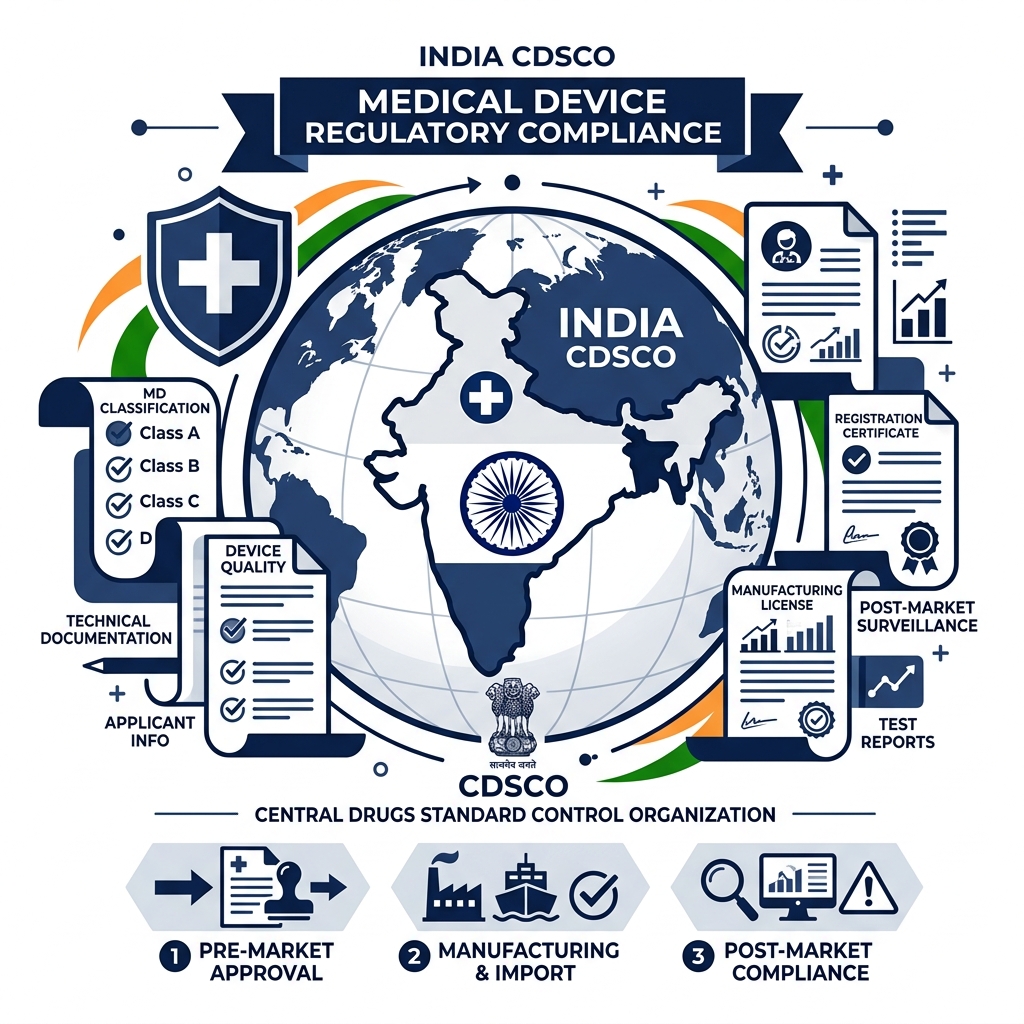
How to Register a Medical Device in India | The Complete 2026 CDSCO Guide
Learn how to register a medical device in India: CDSCO classes, MD forms, documents, fees and timelines explained step by step for 2026.
Read Full Guide
EU MDR 2026: EUDAMED, Classification & Compliance Priorities
EUDAMED's first four modules are now mandatory. Review the registration, UDI/device, certificate and market-surveillance implications manufacturers should address now.
Read Full Guide
FDA Medical Device Inspections in 2026: Preparing for the New QMSR Framework
FDA has moved away from QSIT to the QMSR-aligned inspection process. Learn what investigators may review and how to strengthen inspection readiness.
Read Full Guide
EU AI Act and Medical Devices: What MedTech Manufacturers Need to Get Right
A practical regulatory perspective for manufacturers developing AI-enabled medical devices and medical software for the European market.
Read Full GuideEU MDR Compliance: Where Medical Device Manufacturers Commonly Get Stuck
A practical regulatory perspective on the issues that can delay CE marking and EU market entry under Regulation (EU) 2017/745.
Read Full Guide
India Medical Device Rules 2026: EU-Approved Devices Gain Recognition Under Rule 63
What the latest MDR amendment (G.S.R. 744(E)) means for medical device manufacturers, EU companies and Indian importers.
Read Full Guide
Medical Device Documentation: From Compliance Records to Regulatory Evidence
Why auditors look for lifecycle traceability and how to turn static technical files into defensible regulatory evidence during inspections.
Read Full Guide
CE Marking for Digital Health: Define the Product Before Planning the Evidence
Plan EU medical software qualification, classification, clinical evidence, and release controls around a clearly defined intended purpose.
Read Full Guide
FDA QMSR Readiness: Follow a Product Record Through the Quality System
Assess FDA QMSR readiness through connected product records, supplier controls, complaints, and management decisions rather than a document count.
Read Full Guide
Software Risk Management After Release: Turn New Signals Into Decisions
Connect software incidents, dependency updates, and clinical feedback to risk assessment, change control, and verified release decisions.
Read Full Guide
Appointing a PRRC: Make the Responsibility Work Beyond the Contract
Define a workable PRRC arrangement with appropriate qualifications, access to evidence, escalation routes, and clear manufacturer responsibilities.
Read Full Guide
ISO 13485 Documentation: Build a System People Can Use and Auditors Can Trace
Organise medical-device QMS documentation around process ownership, controlled records, traceability, and reliable retrieval.
Read Full Guide
Clinical Equivalence Under EU MDR: Establish What the Comparison Can Support
Evaluate technical, biological, and clinical equivalence, data access, and evidence gaps before relying on another device's clinical data.
Read Full Guide
GSPR Compliance: Turn the Checklist Into an Evidence Map
Build a usable GSPR matrix linking applicable requirements to methods, controlled evidence, product configurations, and unresolved gaps.
Read Full Guide
CDSCO Manufacturing Licences: Prepare the Product and Site Evidence Together
Plan an Indian medical-device manufacturing application around classification, site scope, product evidence, and consistent licence documentation.
Read Full Guide
FDA Class III Strategy: Establish the Regulatory Path Before Committing to Studies
Investigate FDA classification, product codes, and evidence requirements before assuming that a device needs a 510(k) or a PMA.
Read Full Guide
Use GSPRs Early: Convert Regulatory Expectations Into Design Inputs
Use GSPRs during device development to define measurable design inputs, evidence dependencies, and review gates before testing begins.
Read Full Guide
Cardiovascular Device CE Marking: Organise Evidence Around the Clinical Claim
Plan cardiovascular-device evidence across design performance, patient contact, clinical benefit, and follow-up without assuming one route fits all products.
Read Full Guide
IEC 62304 in Practice: Keep Requirements, Risk Controls, and Releases Connected
Organise a medical-device software lifecycle around traceable requirements, risk controls, verification, third-party software, and release records.
Read Full Guide
Remote Patient Monitoring: Define the Clinical Workflow Before the Device Boundary
Assess remote-monitoring systems through their measurement claims, alerts, data flow, home-use conditions, and clinical responsibilities.
Read Full Guide
Class D IVD Verification: Coordinate the Product Evidence and Batch Workflow
Prepare Class D IVD verification with clear configurations, performance evidence, batch records, and notified-body or reference-laboratory interfaces.
Read Full Guide
Dental Scanner Development: Validate the Scan-to-Decision Workflow
Plan dental-scanner evidence for intended use, scan accuracy, software processing, reprocessing, and downstream digital workflows.
Read Full Guide
Borderline Products: Separate Device Qualification From Risk Classification
Assess borderline products using intended purpose, mode of action, claims, and jurisdiction-specific reasoning before selecting a device class.
Read Full Guide
EU MDR Technical Documentation: Make the Evidence Trail Clear
Prepare an MDR technical file with consistent scope, claim-to-evidence links, controlled revisions, and traceable responses to review questions.
Read Full Guide
FDA 510(k) Problems: Diagnose the Evidence Gap Before Responding
Address 510(k) obstacles by distinguishing pathway, intended-use, performance-evidence, and submission-consistency problems.
Read Full Guide
Medical Device CAPA: Show That the Cause Was Addressed
Build CAPA records around problem definition, investigation, cause-based actions, effectiveness measures, and a justified closure decision.
Read Full Guide
Global MedTech Strategy: Sequence Markets Around Reusable Evidence
Separate reusable product evidence from market-specific classification, representation, and submission needs in a global regulatory plan.
Read Full Guide
IVDR Transition Planning: Check Eligibility Before Relying on the Deadline
Assess IVDR legacy-device transition eligibility, application milestones, change restrictions, and evidence before relying on extended dates.
Read Full Guide
ISO 10993 Biological Evaluation: Define the Question Before Ordering Tests
Plan biological evaluation using finished-device contact, materials, processing, available evidence, and current standards-recognition requirements.
Read Full GuideBuild a Medical Device Requirements Register Across Regulatory Disciplines
Create a product-specific register linking device rules, software, electrical safety, biological evaluation, and other applicable obligations.
Read Full Guide
When to Submit a 510(k): Use Readiness Gates Instead of a Calendar Target
Assess 510(k) readiness through intended use, predicate strategy, completed evidence, configuration control, and capacity to answer review questions.
Read Full Guide
Medical Device Usability Testing: Design a Study That Answers the Safety Question
Plan usability evaluations around representative users, critical tasks, realistic conditions, observations, and justified interpretation.
Read Full Guide
510(k) Modernisation: Assess Predicate Relevance and Performance Evidence
Understand predicate relevance, final versus draft guidance, and the limited scope of FDA's Safety and Performance Based Pathway.
Read Full Guide
Human Factors in Device Design: Find Use Problems Before Validation
Integrate human factors into early device design through user research, task analysis, formative evaluation, and traceable design decisions.
Read Full Guide
Medical Device Registration in India: Define the Applicant, Product, and Route
Prepare an Indian medical-device registration strategy using product classification, applicant roles, manufacturing or import scope, and current rules.
Read Full Guide
The EU MDR CE-Marking Process: Plan the Decisions and Handoffs
Sequence EU MDR qualification, classification, evidence, conformity assessment, declaration, and ongoing obligations in a practical project plan.
Read Full Guide
FDA SaMD Planning: Assess the Software Function Before Selecting a Submission
Define medical software functions, assess FDA regulatory treatment, and connect classification and submission evidence to the intended use.
Read Full Guide
FDA Pre-Submissions: Ask Questions That Resolve a Development Decision
Prepare a focused FDA Pre-Submission with a defined device, evidence context, proposed approach, and questions tied to development decisions.
Read Full Guide
Selecting a Notified Body: Match Designation, Scope, and Project Readiness
Choose a notified body by confirming designation scope, product fit, assessment requirements, and realistic readiness rather than quoted timing alone.
Read Full Guide
FDA QMSR 2026: What Medical Device Manufacturers Need to Know
QMSR is now effective. Understand the key changes, ISO 13485 alignment, record expectations and practical actions manufacturers should take for ongoing FDA compliance.
Read Full GuideEU MDR 2026: EUDAMED, Classification & Compliance Priorities
EUDAMED’s first four modules are now mandatory. Review the registration, UDI/device, certificate and market-surveillance implications manufacturers should address now.
Read Full GuideFDA Medical Device Inspections in 2026: Preparing for the New QMSR Framework
FDA has moved away from QSIT to the QMSR-aligned inspection process. Learn what investigators may review and how to strengthen inspection readiness.
Read Full GuideNeed expert guidance on your medical device regulatory strategy?
Connect with NKB Regovanta's senior specialists for US FDA, EU MDR, CDSCO, and international compliance assurance.