
European Regulatory Framework
IVD Regulation in the EU - IVDR 2017/746
The European Union overhauled its diagnostic framework with the introduction of the In Vitro Diagnostic Medical Devices Regulation (IVDR) 2017/746. Fully replacing the outdated IVDD, this regulation introduces significantly stricter clinical evidence requirements, mandates extensive Notified Body involvement, and relies heavily on the EUDAMED database.
The IVDR Classification Paradigm Shift
Under the previous IVD Directive (IVDD), nearly 80% of diagnostic devices could be self-certified by the manufacturer. The implementation of IVDR has fundamentally reversed this statistic. Today, approximately 80% of all IVDs require conformity assessment by an independent Notified Body before they can be placed on the European market.
EU IVDR Classification Matrix
| Class | Risk Level | Examples | Assessment Pathway |
|---|---|---|---|
| Class A | Lowest risk | Lab equipment, general reagents | Self-declaration (unless sterile) |
| Class B | Moderate risk | Urine analysis, general serology tests | Notified Body mandatory |
| Class C | High individual risk | Cancer screening, companion diagnostics | Notified Body + EURL |
| Class D | High public health risk | HIV, HBV, blood screening products | Notified Body + EURL + Common Specs |
Core IVDR Requirements
Rigorous Performance Evaluation
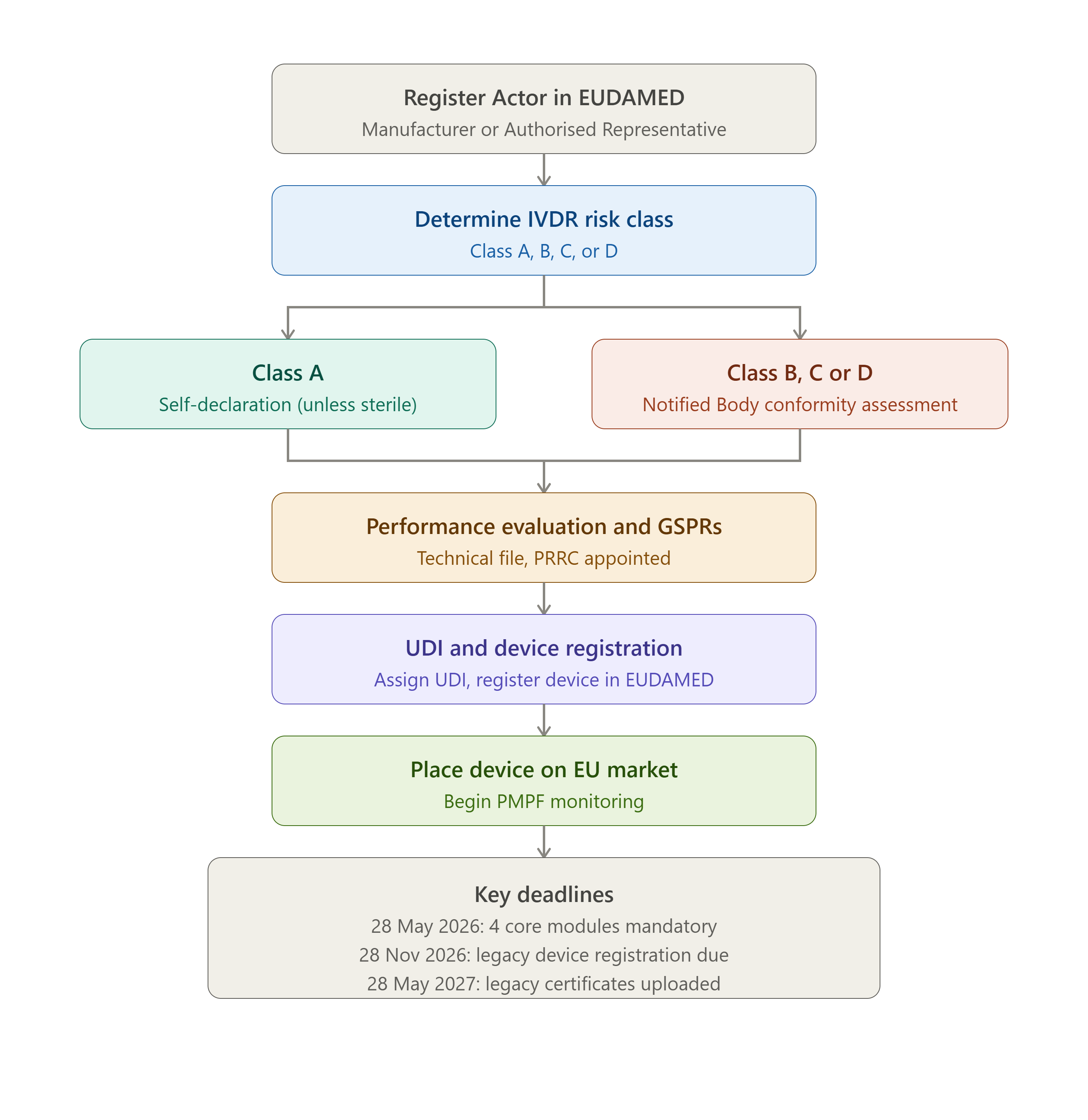
Mandatory for all devices under IVDR. You must compile analytical performance data, clinical performance data, and establish scientific validity. Unlike India, existing clinical data can be utilized if it is scientifically robust, minimizing the need for new trials.
GSPRs and Technical Files
Manufacturers must prove strict conformity to the General Safety and Performance Requirements (GSPRs) found in Annex I. This requires a comprehensive technical file containing design details, risk management, and labeling plans.
Designated PRRC
It is legally required to appoint a Person Responsible for Regulatory Compliance (PRRC) who possesses specific technical and regulatory qualifications to oversee continuous compliance.
PMPF and UDI Systems
Post-Market Performance Follow-up (PMPF) ensures proactive device monitoring post-launch. Furthermore, all devices must be assigned a Unique Device Identifier (UDI) and be registered within EUDAMED.
EUDAMED Transition Timelines
The most critical development for 2025–2026 is the mandatory rollout of EUDAMED. As per Commission Decision (EU) 2025/2371, four core EUDAMED modules are fully functional and will transition from voluntary to mandatory status on 28 May 2026. Any obligation linked to Actor Registration, UDI/Device Registration, Notified Bodies & Certificates, or Market Surveillance must be fulfilled exclusively within EUDAMED.
- 28 May 2026:Mandatory use of the first four EUDAMED modules goes live. If you export to the EU, your Authorised Representative must be registered in the Actor module prior to this date.
- 28 November 2026:Final deadline to register legacy devices (those placed on the market before May 2026 but continuing to be sold).
- 28 May 2027:Notified Bodies must complete the upload of all legacy IVDR certificate information.
Key Legislative Amendments
Four additional regulations have been enacted with the primary purpose of providing adequate time and resources to ensure continued availability of devices on the EU market:
| Regulation | Key Provisions |
|---|---|
| (EU) 2022/112 |
|
| (EU) 2023/503 |
|
| (EU) 2023/607 |
|
| (EU) 2024/1860 |
|
IVDR Transition Timeline
Only “legacy” devices meeting the following conditions can benefit from the IVDR transition timelines:
- a) those devices continue to comply with Directive 98/79/EC;
- b) there are no significant changes in the design and intended purpose;
- c) the devices do not present an unacceptable risk to the health or safety of patients, users or other persons, or to other aspects of the protection of public health;
The transition period depends on the classification of the device and whether it was CE-marked under the IVDD by self-declaration or by certification with a Notified Body. The following timelines apply:
Devices with an IVDD certificate
- 26 May 2025 – Implement IVDR-compliant quality system
- 26 May 2025 – Apply to a notified body
- 26 September 2025 – Conclude a written agreement with a notified body
- 31 December 2027 – End of transition period
Class D devices
- 26 May 2025 – Implement IVDR-compliant quality system
- 26 May 2025 – Apply to a notified body
- 26 September 2025 – Conclude a written agreement with a notified body
- 31 December 2027 – End of transition period
Class C devices
- 26 May 2025 – Implement IVDR-compliant quality system
- 26 May 2026 – Apply to a notified body
- 26 September 2026 – Conclude a written agreement with a notified body
- 31 December 2028 – End of transition period
Class B devices
- 26 May 2025 – Implement IVDR-compliant quality system
- 26 May 2027 – Apply to a notified body
- 26 September 2027 – Conclude a written agreement with a notified body
- 31 December 2029 – End of transition period
Class A sterile devices
- 26 May 2025 – Implement IVDR-compliant quality system
- 26 May 2027 – Apply to a notified body
- 26 September 2027 – Conclude a written agreement with a notified body
- 31 December 2029 – End of transition period
Class A (non-sterile) devices
Transition period does not apply – full compliance required as of 26 May 2022.
Preparing for Certification
To ensure a smooth certification process, manufacturers should prioritize the following steps before applying to a Notified Body:
- Ensure your quality management system complies strictly with IVDR Article 10(8).
- Prepare robust technical documentation in accordance with IVDR Annexes II and III.
- Assess whether existing data (from IVDD or non-EU markets) is adequate to demonstrate compliance, and generate new data to address any gaps.
- Engage in structured dialogue early to clarify procedural aspects before formal submission.
Further IVDR Details & Procedures
Structured dialogue
The complex development process for most types of medical devices, combined with the need to address new regulatory requirements and obtain Notified Body approval, is likely to make the transition a complicated and time-consuming process for most device manufacturers. Further, previously approved devices are not exempt from the new regulation's requirements and will need to be re-evaluated and re-approved.
The purpose of a structured dialogue prior to lodging a formal IVDR application is to clarify the timing, procedural, and regulatory aspects of the application process and forms, and the submission documents. These structured dialogues are an opportunity to meet with the Notified Body before the application for a conformity assessment and are independent of the assessment.
Possible topics for structured dialogue include:
- Application & Onboarding: Onboarding process, application forms & review process, sites & suppliers, and device classification & code assignment.
- Topics of manufacturer: Testing & certification regulations, framework agreements, handling of device changes, and transferring to a Notified Body.
- Conformity Assessment Procedure: Project planning, time limits, special procedures (e.g. consultation), submission requirements, costs & fees, and harmonised standards.
IVDR application procedure
Based on the product classification, the manufacturer must apply for an applicable conformity assessment procedure.
Please note: Not all Notified Bodies provide conformity assessment services according to IVDR Annex X. At lodging of an application of IVDR Annex XI for class C and D devices, the manufacturer needs to provide a copy of the EU type-examination certificates issued by the notified body designated for conformity assessment activities related to the types of devices concerned.
English and/or German are the generally acceptable languages for the submission of documentation and any related correspondence to major Notified Bodies.
Certification costs
The certification costs are based on hourly rates. They consider factors such as the size of the company, number of sites, and number and complexity of devices. Major Notified Bodies typically base their fee structure mainly on effort-related criteria to enable a precise and individual cost calculation.
Standard benchmark fees for conformity assessment activities (as referenced by leading Notified Bodies) are typically:
| Audit and QM System Assessment Services | ~ 350 € per hour |
| Technical Documentation Assessment Service | ~ 465 € per hour |
| Application Management Fee | ~ 2,800 € per case |
| Initial Assessment of Vigilance Information | ~ 420 € (cases 1-200) |
*Depending on the location of the manufacturer and possibility to include local experts or auditors in the conformity assessment procedure, actual prices may vary, and fees may be invoiced in local currency.
IVDR resources
Ensure a smooth process of complying with the IVDR with key checklists and guidance resources:
- Audit Checklists: Prepare using the IVDR QM System Requirements and IVDR Technical Documentation Submission Requirements checklists.
- IVDR Sampling: Understand how Notified Bodies implement the requirements of sampling for Class B and Class C devices under the IVDR.
- Legacy Products under IVDR: Information on how products that are already on the market under the old In Vitro Diagnostic Directive (IVDD) can transition to IVDR.
- IVDR Companion Diagnostics (CDx): Guidance on successfully completing IVDR certification for CDx devices.
- IVDR Class D: Information on the provisions for special scrutiny of high-risk Class D devices.
- IVDR Classification: Information on medical device classification under the IVDR (EU) 2017/746.
Our IVDR Compliance Solutions
From navigating Notified Body backlogs to ensuring your EUDAMED data is perfectly structured ahead of impending deadlines, our experts streamline your European market access.
Notified Body Representation
We support you through the rigorous conformity assessments required by EU Notified Bodies for Class B, C, and D devices.
EUDAMED Registration
Ensure seamless market access by registering your Actor details and UDI/Device information in EUDAMED before the May 2026 deadline.
Clinical Evidence & PMPF
Develop robust analytical and clinical performance reports, and establish proactive Post-Market Performance Follow-up (PMPF) plans.
Technical Documentation
Compile comprehensive technical files ensuring strict alignment with the General Safety and Performance Requirements (GSPRs) of Annex I.