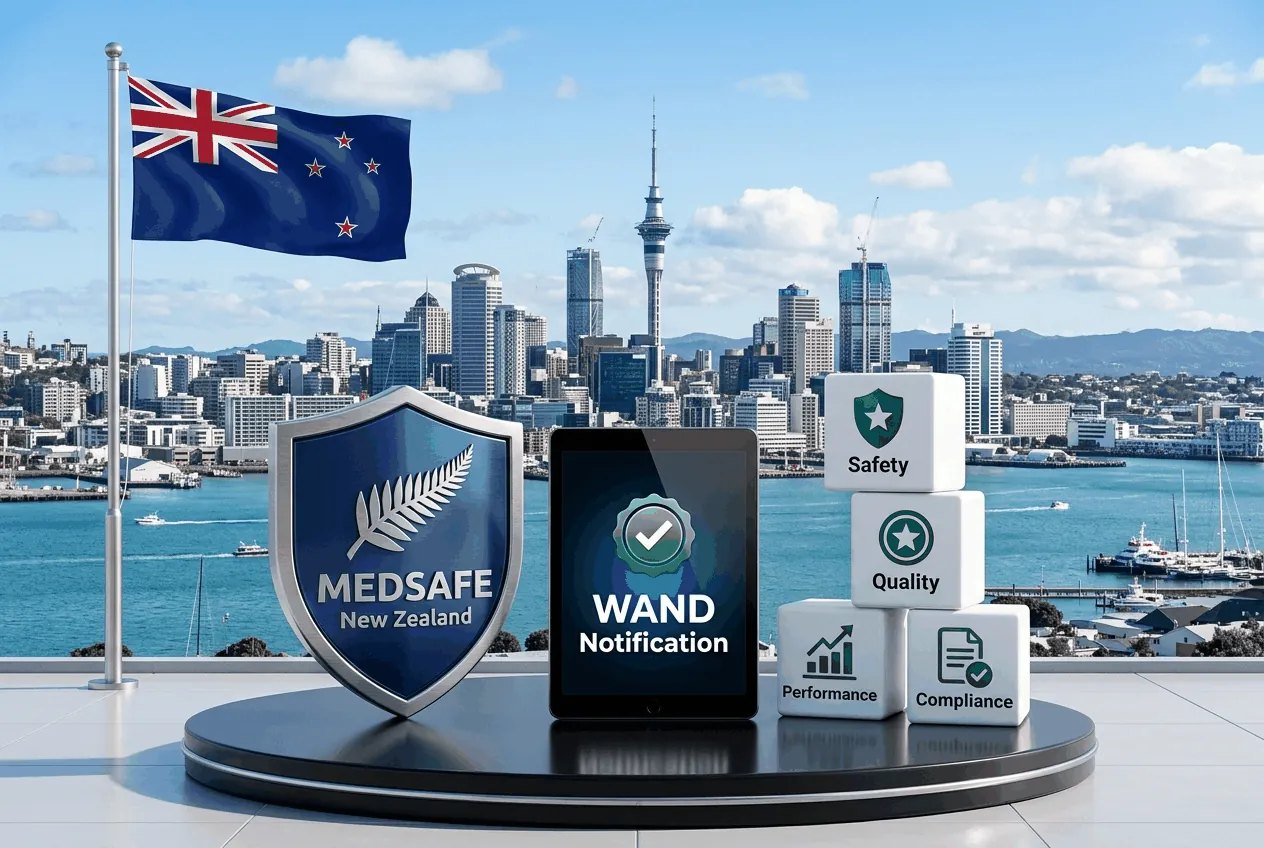
New Zealand WAND Notification & Medsafe Compliance
Your Partner for Successful Market Access in New Zealand
We help medical device, IVD and software manufacturers achieve WAND notification and Medsafe compliance with the right strategy, documentation and regulatory expertise for a faster and smoother market entry in New Zealand.
End-to-End Support
From qualification to WAND & post-market vigilance
WAND Notification Experts
Specialized in Medsafe database records & GMDN descriptors
NZ Sponsor Support
Legally responsible in-country representation & oversight
Faster Market Entry
Streamlined 5-10 day notification turnaround
Compliance You Can Trust
Strict adherence to Medicines Act & 2003 Regulations
WAND Notification (Medical Devices & SaMD)
Mandatory database notification for most medical devices and Software as Medical Devices (SaMD) supplied in New Zealand.
Not an approval – a legal requirement for supply in NZ.
IVDs Exempt from WAND Notification
IVDs are currently exempt from mandatory WAND notification, however other obligations (sponsor, labeling, evidence, post-market) continue to apply.
Complete New Zealand Regulatory Services Suite
1. Regulatory Strategy & Product Classification
- •Define the right pathway for your device in New Zealand
- •Product classification as per Schedule 2 risk framework
- •Class I, Is, Im, IIa, IIb, III & AIMD assessment
- •GMDN code selection & WAND grouping strategy
2. WAND Notification & Sponsor Readiness
- •End-to-end WAND notification submission support
- •Prepare and review notification details & GMDN descriptors
- •Manufacturer and sponsor data alignment & verification
- •Post-notification updates & 30-day statutory filings
3. New Zealand Sponsor Services
- •Act as or coordinate your local Sponsor in NZ
- •Legal sponsor responsibilities & Medsafe liaison
- •Distribution records, complaint intake & recall readiness
- •Renewal & lifecycle maintenance governance
4. Technical Documentation & Review
- •Device description, intended use & specifications
- •Risk management (ISO 14971) & verification evidence
- •Essential safety/performance substantiation file
- •Clinical evaluation, labeling & PMS plan summary
5. Testing Strategy & Laboratory Coordination
- •Test plan based on risk & device classification
- •Coordination with accredited/recognized laboratories
- •Electrical safety, EMC, performance & biocompatibility
- •Test report review & evidence gap closure
6. IVD Regulatory & Performance Evidence
- •IVD regulatory status & voluntary WAND strategy
- •Analytical & clinical performance evidence review
- •Stability, calibrator traceability & shelf-life studies
- •Labeling & IFU compliance for New Zealand
7. SaMD / Software / AI & Cybersecurity
- •SaMD classification & WAND notification strategy
- •Software life cycle documentation (IEC 62304)
- •Cybersecurity risk management & data protection
- •AI/ML algorithmic transparency & clinical validation
8. Labeling, IFU & Advertising Compliance
- •Labeling & IFU review as per NZ requirements
- •Manufacturer and sponsor identification on packaging
- •Packaging compliance & standard symbol verification
- •Advertising & promotion compliance (Medsafe rules)
9. Post-Market Surveillance, Vigilance & Recalls
- •PMS plan development & complaint triage
- •Adverse event reporting to Medsafe (10-day rule)
- •Field Safety Corrective Actions (FSCA) & recall execution
- •Trend analysis & annual PMS reporting
10. QMS & Compliance Readiness
- •Quality system gap assessment (ISO 13485)
- •Technical documentation & record retention controls
- •Internal audit & management review support
- •Distribution records & Medsafe audit readiness
11. Change, Variation & Lifecycle Support
- •Change classification & regulatory impact assessment
- •WAND notification update & correction submission
- •Technical file update & sponsor record maintenance
- •End-to-end lifecycle governance
12. Medsafe Queries, Deficiency & Response
- •Handling Medsafe inquiries & safety review requests
- •Deficiency response & scientific rebuttal drafting
- •Technical review meetings & liaison support
- •Document re-submission & time-bound closure
13. Importer, Distributor & Supply Chain
- •Importer requirements & multi-importer WAND mapping
- •Distribution & storage traceability controls
- •Complaint escalation pathways & recall readiness
- •Local supply chain compliance & Medsafe audit support
Our End-to-End WAND Notification Process
Typical timeline: 5–10 working days (subject to completeness of information)
Strategy & Qualification
Confirm device status, intended purpose, NZ risk class and WAND applicability.
Information Collection
Gather GMDN, manufacturer details, intended purpose, and technical evidence.
WAND Submission
Submit prescribed electronic notification to Medsafe within statutory 30-day window.
Medsafe Review
Respond to database validation questions, data alignments, or Medsafe queries.
Notification Confirmation
Obtain confirmed WAND listing record and establish sponsor distribution controls.
Post-Market Compliance
Manage adverse events, 10-day reporting, recalls, WAND updates, and ongoing compliance.
Why Choose NKB Regovanta for New Zealand?
Ready to Enter the New Zealand Market?
Partner with NKB Regovanta for seamless WAND notification, Medsafe compliance and market access.
Contact Our NZ Experts Today!Comprehensive New Zealand Medsafe Regulatory Framework
Explore our in-depth methodologies, strategic frameworks, and regulatory decision pathways for New Zealand.
1. Regulatory Strategy & Product Classification
Classification Drives the New Zealand Sponsor and WAND Strategy. New Zealand uses a GHTF-based medical-device classification framework with Class I, Class I sterile/measuring, Class IIa, Class IIb, Class III and AIMD categories. Classification is determined using the rules in Schedule 2 and must be assigned by the New Zealand Sponsor when notifying a device to WAND.
Classification Elements
- • Product qualification and regulatory-status assessment
- • Intended purpose and clinical claims review
- • Schedule 2 risk-class determination
- • Class I, Is/Im, IIa, IIb, III and AIMD assessment
- • Accessory, procedure pack and system considerations
Our Support Scope
- • SaMD / software regulatory-status and classification assessment
- • GMDN code and descriptor selection strategy
- • Assessment of WAND notification vs statutory exemption
- • Regulatory roadmap from sponsor appointment through post-market
- • Cross-market equivalence review (EU MDR, TGA, US FDA)
Classification Approach:
We do not simply map a foreign-market class into New Zealand. We apply the New Zealand rules and then trace that classification into the WAND data set, grouping strategy, sponsor declaration, technical-evidence expectations and post-market controls.
2. WAND Notification & Sponsor Readiness
WAND Notification Is a Legal Notification — Not a Product Approval. For most medical devices, the New Zealand Sponsor must notify prescribed information to the Web Assisted Notification of Devices (WAND) database within 30 calendar days of becoming the sponsor. The sponsor is also responsible for ensuring that notified information remains accurate and is corrected when it changes.
WAND Submission Data
- • WAND sponsor account setup and readiness
- • Manufacturer detail verification and validation
- • Risk-class and GMDN code review
- • Product identifier review for higher-risk devices
- • Grouping assessment for eligible device models
Lifecycle Database Controls
- • Notification submission & confirmation verification
- • Review of WAND record post-notification
- • Correction and update support when device details change
- • Sponsor-detail and administrator change filings
- • Multi-importer notification synchronization
WAND Quality Rule:
We quality-check the regulatory basis behind each WAND field. The objective is not just to complete the database entry, but to ensure the sponsor can stand behind the classification, GMDN, manufacturer details, intended purpose and device information declared in WAND.
Frequently Asked Questions (Medsafe & New Zealand)
Key questions manufacturers ask when registering medical devices, IVDs and SaMD in New Zealand.
Does WAND notification mean Medsafe has approved my medical device?
No. WAND is a notification database. Notification does not indicate approval or endorsement by Medsafe. The sponsor remains responsible for meeting the applicable legal requirements and for the safety of the device supplied.
Who can be the New Zealand Sponsor?
The sponsor is a New Zealand entity that imports, exports, manufactures, or arranges manufacture of the device for supply as defined in the Medicines (Database of Medical Devices) Regulations 2003.
When must a device be notified to WAND?
For devices subject to mandatory notification, the sponsor is required to notify the device within 30 calendar days of becoming the sponsor. Medsafe guidance interprets this period for imports as commencing when the device first arrives in New Zealand.
Are IVDs required to be notified to WAND?
No. IVDs are currently exempt from mandatory WAND notification, although voluntary notification is available. They remain subject to other requirements of the Medicines Act and associated Regulations.
What are the New Zealand device risk classes?
The WAND framework includes Class I, Class I sterile and/or measuring, Class IIa, Class IIb, Class III and AIMD. IVD is available as an optional WAND classification for voluntary notification.
Can I use my EU or Australian classification directly in New Zealand?
Not automatically. New Zealand uses its own Schedule 2 classification rules. Differences can exist between New Zealand and overseas classification systems, so the local class should be independently assessed.
Do multiple New Zealand importers need separate WAND notifications?
Potentially yes. Medsafe states that WAND notification is specific to the sponsor-device combination, so multiple importers of the same device can each have notification obligations.
What information is needed for WAND?
The WAND data set includes sponsor and manufacturer details, risk classification, GMDN information and additional device information required by the Regulations, with product identifiers for specified higher-risk categories.
Can NKB Regovanta coordinate testing laboratories for New Zealand?
Yes. We can help define the regulatory testing strategy, coordinate with established laboratories and assess protocols and reports against the intended purpose, risk controls and evidence needs of the New Zealand product.
What happens if WAND information changes?
The sponsor must keep notified information accurate. Medsafe guidance states that information that becomes inaccurate or incorrect should be corrected within the applicable regulatory timeframe.
What are the sponsor's post-market responsibilities?
Sponsors should maintain distribution records, complaint and investigation controls, report relevant adverse events, and be capable of conducting recall or corrective actions in consultation with Medsafe.
How quickly should serious medical-device incidents be reported?
Medsafe recommends that death and serious-injury events be reported as soon as possible and within 10 calendar days, with a final report after the investigation is completed.
Does a WAND notification require a full technical dossier submission?
WAND itself is not a technical-dossier approval process. However, the sponsor should have access to sufficient technical and safety evidence to substantiate the device and respond to Medsafe safety or compliance questions.
Can software be notified to WAND?
Software that meets the New Zealand definition of a medical device should be assessed for classification and WAND applicability in the same regulatory framework as other medical devices.
Can NKB support recalls or field corrective actions in New Zealand?
Yes. We can support risk assessment, sponsor-manufacturer coordination, Medsafe communication, customer identification, corrective-action documentation and lifecycle updates in line with the New Zealand Medicines and Medical Devices Recall Code.
Your Regulatory Partner for New Zealand Market Access
Whether you are appointing your first New Zealand Sponsor, determining WAND applicability, notifying a medical device, assessing an IVD exemption, reviewing technical evidence, planning laboratory testing, preparing for Medsafe questions or strengthening post-market controls, NKB Regovanta supports the complete New Zealand regulatory lifecycle.