US Regulatory Framework
IVD Regulation in the USA - US FDA Framework
In the United States, In-Vitro Diagnostic devices are regulated by the FDA's Center for Devices and Radiological Health (CDRH) under the FD&C Act. The US framework relies heavily on a tiered, risk-based classification system determining the correct premarket pathway—from 510(k) notifications to rigorous PMAs.
FDA Classification & Key Pathways
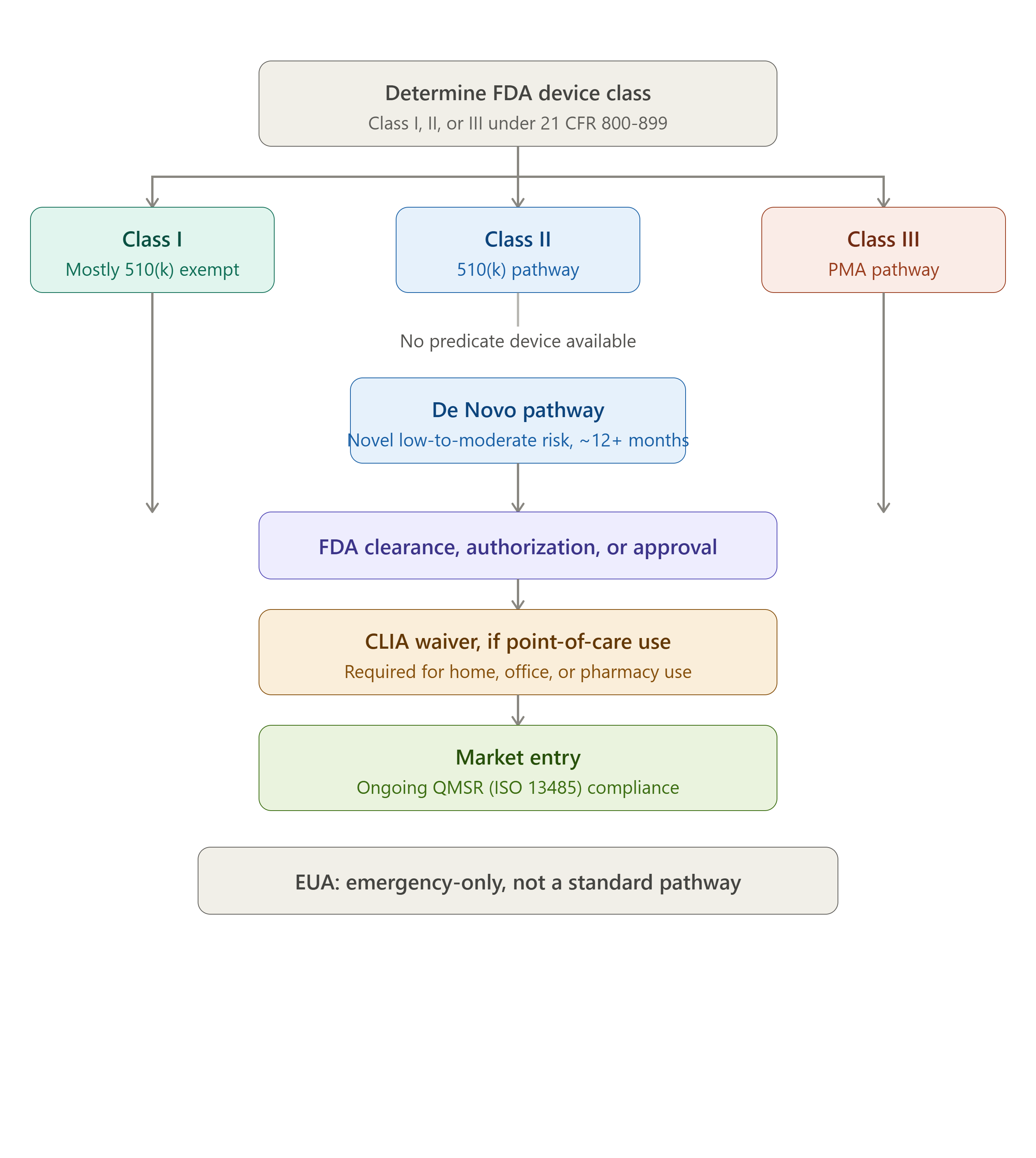
The FDA categorizes IVDs into three distinct classes (Class I, II, and III) under 21 CFR Parts 800–899. This classification directly dictates the level of regulatory control and the corresponding submission pathway required to legally market the diagnostic device.
510(k) Clearance
Class I / II
The dominant pathway for Class II IVDs. Approval hinges on proving "substantial equivalence" to a legally marketed predicate device. Manufacturers must submit comprehensive analytical data (sensitivity, specificity, interference) and, if analytical data is insufficient, clinical performance studies.
Timeline: Target 90 days (Realistically 3–6 months with AI requests)
De Novo Request
Novel Class I / II
Utilized for low-to-moderate risk novel diagnostics that lack a viable predicate device. The FDA independently evaluates the device, establishes necessary special controls, and creates a new classification regulation for future predicates.
Timeline: Typically 12+ months
PMA (Premarket Approval)
Class III
Reserved for high-risk diagnostics (e.g., companion diagnostics, blood screening, HIV tests). This is the most stringent pathway, requiring indisputable scientific evidence of both safety and effectiveness drawn from extensive clinical trials.
Timeline: 18–36 months
If your Point-of-Care (POC) IVD is intended for use outside of a highly regulated, traditional laboratory—such as in pharmacies, physician offices, or for at-home use—securing a CLIA (Clinical Laboratory Improvement Amendments) waiver is an absolute commercial necessity.
Without this waiver, your diagnostic test is legally restricted to certified laboratories, drastically limiting market adoption. Securing a waiver requires specialized analytical studies proving the test is foolproof and poses minimal risk of harm from erroneous results in non-laboratory settings.
Key FDA Regulatory Shifts (2025–2026)
Laboratory Developed Tests (LDT) Final Rule
Finalized in 2024, the FDA is aggressively phasing in requirements for laboratories that develop and utilize their own in-house diagnostic tests. This historic shift dramatically expands FDA oversight over hospital and reference lab diagnostics.
AI/ML-Based IVD Guidance (PCCP)
As diagnostics increasingly rely on Artificial Intelligence and Machine Learning, the FDA is refining its Predetermined Change Control Plan (PCCP) framework. This allows manufacturers to pre-specify planned algorithm modifications, bypassing the need for continuous new regulatory submissions.
QMSR Alignment (2026 Deadline)
The FDA’s updated Quality Management System Regulation (21 CFR Part 820) will take full effect in 2026. All medical device and IVD manufacturers must align their existing quality systems with the international ISO 13485:2016 standard.
Our US FDA Compliance Solutions
From meticulously drafting 510(k) submissions to executing complex CLIA waiver usability studies, we secure your diagnostic product’s position in the US market.
510(k) & Pre-Submission
We expertly map substantial equivalence to predicates and manage the Q-Submission process to align expectations with the FDA prior to formal review.
CLIA Waiver Strategy
For Point-of-Care diagnostics, we design and execute the specialized analytical and usability studies required to secure CLIA waiver status.
LDT Compliance
Navigate the FDA's finalized phase-in oversight for Laboratory Developed Tests (LDTs) with our targeted quality and submission transition plans.
QMSR Alignment
We help transition your current 21 CFR Part 820 quality system to strictly align with the upcoming ISO 13485-based QMSR requirements.