Indian Regulatory Framework
IVD Regulation in India - CDSCO Under MDR 2017
In-Vitro Diagnostic (IVD) devices in India are stringently governed by the Medical Devices Rules (MDR) 2017. As the regulatory landscape matures, the Central Drugs Standard Control Organization (CDSCO) has implemented rigorous classification parameters and mandatory local performance evaluations for higher-risk devices, making expert guidance essential for successful market entry.
Authority, Framework, and Classification
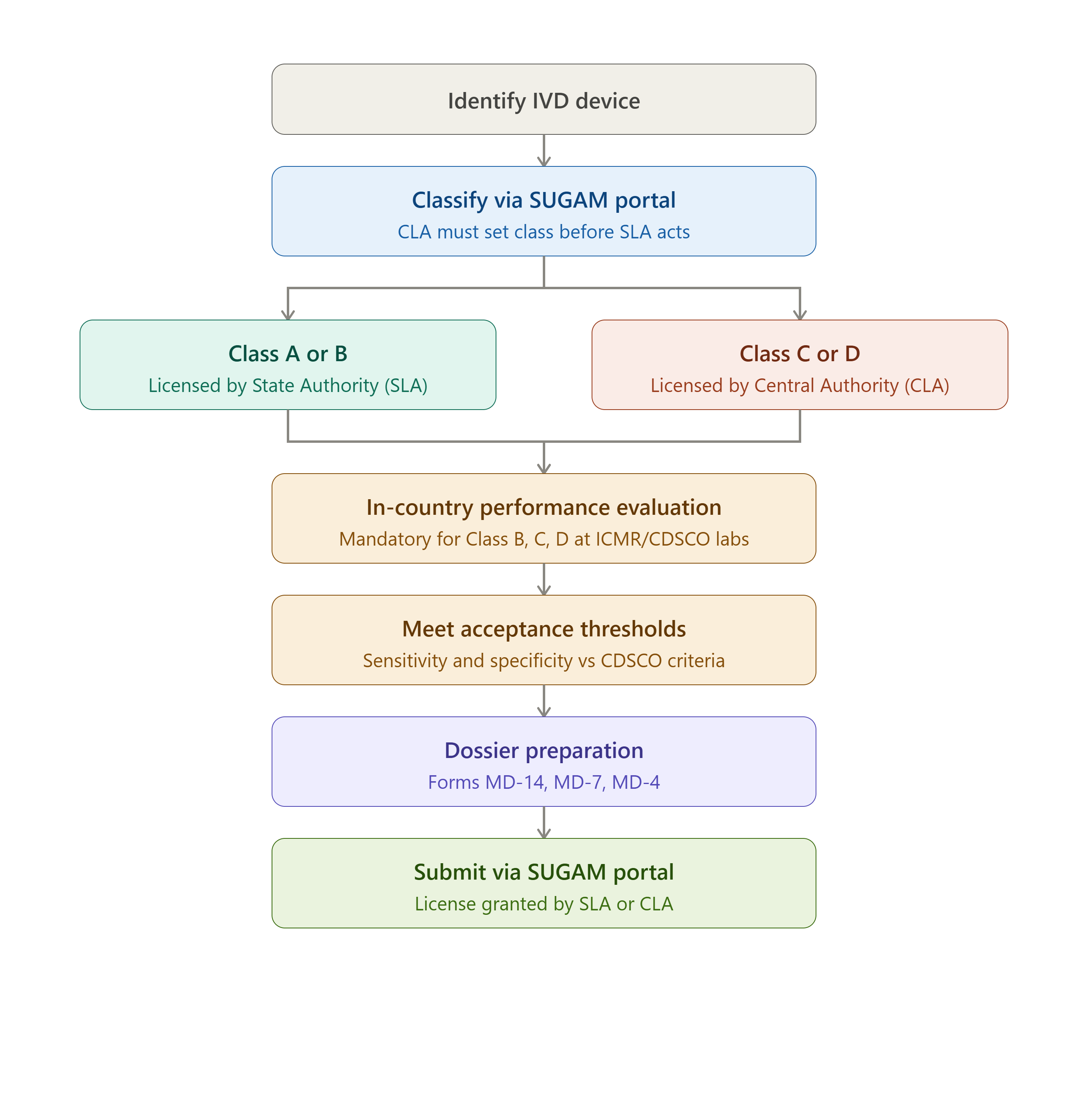
The Indian IVD market is regulated by the CDSCO under the oversight of the Drugs Controller General of India (DCGI), acting as the Central Licensing Authority (CLA). The CLA maintains jurisdiction over the import of all IVD classes, the manufacturing of high-risk (Class C and D) devices, and the approval of novel IVDs. Conversely, State Licensing Authorities (SLAs) handle manufacturing licenses for lower-risk (Class A and B) devices.
India IVD Risk-Based Classification
| Class | Risk Level | Examples | Authority |
|---|---|---|---|
| Class A | Low — general lab use | General chemistry reagents, non-diagnostic lab instruments | SLA |
| Class B | Low-Moderate | Pregnancy tests, blood glucose meters | SLA |
| Class C | Moderate-High | Cancer screening, genetic disease testing, HCV kits | CLA (CDSCO) |
| Class D | High public health risk | HIV diagnostics, blood group serology | CLA (CDSCO) |
The India-Specific Requirement: In-Country Performance Evaluation
India's regulatory framework features a unique and pivotal requirement: mandatory in-country clinical performance evaluation for new Class B, C, and D IVD devices. Unlike many markets that rely on mutual recognition, India strictly requires local performance data, even if your device holds CE marking under the IVDR or FDA 510(k) clearance.
Evaluation Criteria
- Testing must be conducted at CDSCO-authorised and ICMR-designated labs.
- Sensitivity, specificity, and accuracy are assessed against strict CDSCO acceptance thresholds.
- Minimum sample requirements are strictly enforced according to ICMR protocols.
Standardized Thresholds
Examples of ICMR-CDSCO minimum acceptance criteria:
- ELISA Sens: ≥90% | Spec: ≥95%
- Rapid Test (RDT) Sens: ≥80% | Spec: ≥90%
- PCR Assay Sens: ≥95% | Spec: ≥98%
Key 2025–2026 Regulatory Updates
- CDSCO Authorised Laboratories List (Jan 2026)An updated nationwide list of authorised laboratories for IVD evaluation was published, mapping critical disease categories (HIV, TB, SARS-CoV-2, dengue, etc.) to specific government and ICMR/AIIMS facilities. Use of these exact labs is now mandatory.
- ICMR-CDSCO IVD Innovators HandbookMedTech Mitra released a stage-wise roadmap covering proof of principle, clinical performance evaluation, QMS implementation, and MDR 2017 form checklists.
- Draft Guidance for IVD Import (Jan 2026)A new guidance document was released covering application pathways, timelines, and common non-compliances seen in IVD import applications.
Our CDSCO Compliance Solutions
We navigate the intricacies of the Medical Devices Rules 2017 and coordinate local performance evaluations to guarantee your IVD product is market-ready in India.
SUGAM Portal Registration
We manage end-to-end import and manufacturing registrations via the CDSCO SUGAM portal, ensuring smooth dossier submission and tracking.
In-Country Performance Evaluation
We coordinate mandatory local clinical performance evaluations at ICMR/AIIMS-designated laboratories to meet strict CDSCO requirements.
Classification & Strategy
We determine the correct risk class for your IVD under Part II of the First Schedule and strategize your licensing pathway (CLA vs SLA).
Dossier Preparation
Comprehensive preparation of Forms MD-14, MD-7, and MD-4, aligning your technical documents with the latest 2025/2026 MDR 2017 guidelines.