
Converting a Legacy Technical File to MDR Without Rebuilding Everything From Zero
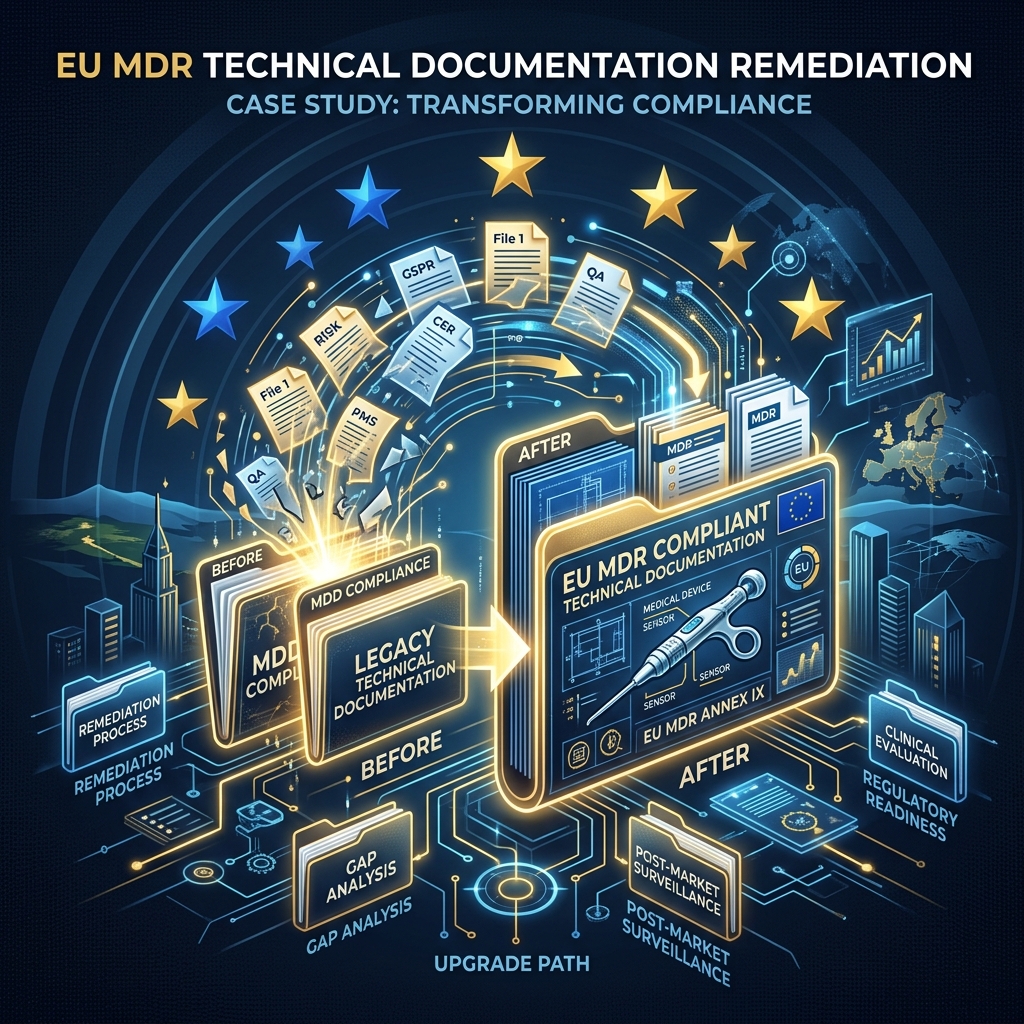
Client profile: Established medical-device manufacturer transitioning a mature product and legacy technical documentation to Regulation (EU) 2017/745.
The Challenge
The manufacturer had years of design, verification, risk, clinical and post-market documentation, but the information had been created under an earlier regulatory framework and was not organized around MDR expectations.
The internal assumption was that “MDR means rewrite everything,” creating a large remediation project with significant cost and document churn.
The Route That Could Have Cost More Time or Money
Rebuilding the entire technical file from blank templates, even where legacy evidence remained valid and useful.
What We Did
- Mapped existing evidence against MDR Annex II and Annex III expectations and created a prioritized gap register.
- Separated content that could be retained, content that needed updating, and genuinely missing evidence.
- Rebuilt traceability between GSPRs, risk management, verification/validation, clinical evaluation, labeling, PMS and PMCF activities.
- Focused remediation on regulatory gaps rather than document replacement for its own sake.
- Reorganized the final technical documentation into a clear, searchable structure suitable for conformity-assessment review.
What NKB Did Differently
We treated the project as evidence remediation and traceability engineering—not as a document-writing exercise.
How It Helped
The manufacturer retained valid historical evidence, avoided unnecessary rewriting, and concentrated internal SMEs on the gaps that mattered to MDR conformity.
Business / Regulatory Impact
A more coherent MDR technical file, reduced documentation rework, and better traceability across design, risk, clinical and post-market evidence.
NKB Insight
MDR readiness is not measured by how many documents you rewrite. It is measured by whether the evidence is complete, current, traceable and reviewable.